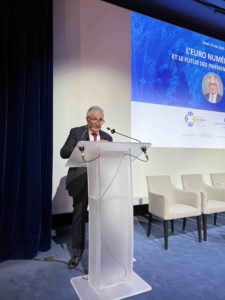
 “Mr the member of the ECB Board and Chairman of the Eurosystem’s High-Level Task Force on the digital euro, Dear Mr Piero Cipollone
Mr The Head of Financial Sector Department (SFE) of the French Treasury, Dear Mr Christophe Bories
Mr The Director General Currency and Retail Payments of Banque de France, Dear Erick Lacourrège
Mr the Deputy Director General of the French Banking Federation, Dear Mr François Lefebvre
Ms Director of the Digital Euro at ECB, Dear Ms WITLOX,
Dear panelists of the two roundtables
Dear friends of FRANCE PAYMENTS FORUM,
Ladies and gentlemen,
Good morning, and thank you for being with us today, in this dark auditoriumr, as we will have a very sunny day outside today.
Thank you for participating in the first conference in Paris about digital euro and the future of payments in Europe. We have already organized some roundtables on digital euro during our events, and also product 3 years ago a first position paper. And, for sure, we will organize other conferences like this one in the coming months and years.
FRANCE PAYMENTS FORUM has a great pleasure to welcome all of you, and I would like to thank particularly the European Central Bank, and Mr CIPOLLONE, to propose us to organize this meeting. It is a great honor, and, if I could add, a great bet.
Thank you, Sir.
For us, it is the recognition of all the work we have done with all my friends here for more than thirteen years to ensure that European issues are at the heart of the French payments’ strategy, and to build together the future of the payments in Europe.
Today, we will try to debate digital euro, and the future of payments in Europe. We must listen to each other, and we must understand each other, because there is no other way of building a competitive European market. I hope this conference will modestly contribute to a consensus and will open the way for a private public cooperation about payments in Europe.
Before entering in our subject today, let me mention that, 30 years ago, in the 14th of March 1995, I went to Brussels for a meeting with the European commission team in charge of preparing the changeover to the single currency (still called the ECU). And the team told me the main issue : In the Maastricht Treaty, we have decided to change for a new single money in 1997, so in two years, and the banks answer us that it’s impossible. Why? And how could we find a scenario for this major political and financial evolution ? that it’s impossible to by-pass, as the Treaty was adopted by referendum in some countries.
I explained my point of view, I proposed a scenario, quickly adopted by Mr Thibault de Silguy and 3 montres after, in June 1995, the European Commission published a green paper and six months later, all the heads of states and governments of the monetary zone gathered in Madrid, the 15th of December 1995.
When we prepared for that in the spring 1995, we had three main ideas: (1) We need a success and then a strong ecu (2) We need a success and for that a consensus between all the stakeholders and (3) we need a success, and then a lot of communication.
And then, I had proposed the scenario that you know : a changeover process that begins, 3 years after, in 1999, with the large amounts payments (wholesale euro), to create a financial critical mass, and to leave enough time (three years more, so six years after the adoption of the Madrid scenario) for preparing the retail phase and the manufacturing of coins and banknotes, and for organizing communication : for the large amounts (wholesale euro), it is easy because there are “only” one million persons around the table, whereas for the retail euro there are 350 million European citizens.
And for this scenario, we get a total consensus between all the stakeholders. And we organize more than 500 meetings all around Europe with citizens and companies.
Today, we must keep in mind that 30 years ago, in December 1995, the European countries had adopted the Madrid scenario for the changeover to euro.
Ladies and gentlemen, today, we have the same challenges and the same responsibilities as in 1995.
Thank you.
Now, we will come back to digital euro.
And to introduce the topic, I have the pleasure to invite M.Piero CIPOLLONE to join me on the stage, and also MM Christophe BORIES, Erick LACOURREGE and François LEFEVRE.
And I invite also my two colleagues, I have to say my two accomplices, Mr Nicolas de Seze, Deputy chairman of our FRANCE PAYMENTS FORUM association, and Mr Olivier VIGNA, Deputy CEO, of Paris Europlace, to come with me for moderating this conference.
M. CIPOLLONE, please, you will be the first speaker of this morning. Thank you for sharing with us your beliefs on the subject.”