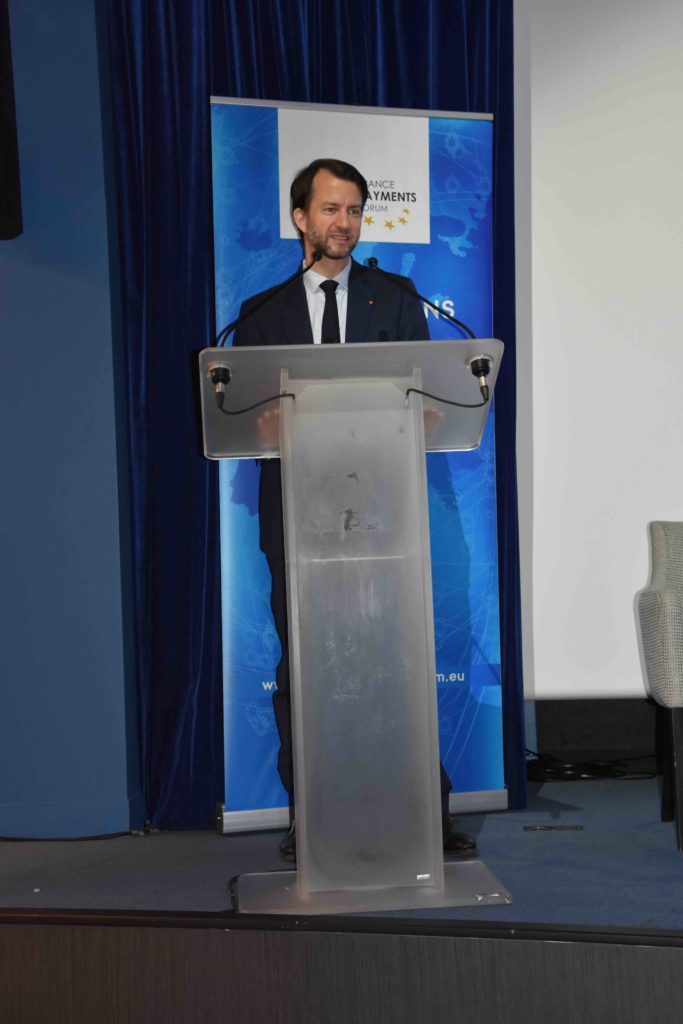
 I would like to thank France Payments Forum for this invitation to open this event dedicated to this very important issue of sovereignty and innovation in European payments.
It is the firm belief of our Ministry that such events and this kind of pivotal moment on this debate are of the utmost importance, because the consensus mentioned in the title of this event is not there, we all know it. It is important that we discuss the different ways we can coordinate and reconcile some different brands of thought on this issue.
As you know, there have been a lot of developments recently. On November 27, the European Parliament and the Council reached a political agreement on the PSD3 package. It will clearly serve as the new cornerstone of European payments regulation. This is a major step forward, we welcome it, and it will be a cornerstone for consumer protection, for strengthening the payment fraud prevention.
In particular, the two texts will clearly also enhance the level-playing-field in Europe, one element on which we are particularly concerned about, because from a regulatory standpoint it will unify and harmonise, and ensure stronger supervision. Those are essential conditions to reduce the fragmenting of the European payments landscape and foster the development of really, truly pan-European paychecks.
As I said, we have a kind of proliferation of initiatives and a kind of redefined and renewed framework at the moment, and the challenge to ensure European sovereignty in payments will be to reconcile all these different initiatives.
I will not dwell too long on the fact that we have a fragmented ecosystem in Europe at the moment. Unfortunately, this is a situation we all know very well, from the regulatory point of view, from the supervision point of view, but also from the market point of view.
Even with the strengthening of the SEPA area, and of course the development of some pan-European public and private infrastructures, we still have this very strong fragmentation, very large divide along national lines. And there are also strong differences between Member States, between countries where some national card schemes were maintained and some where they basically do not exist, and we do not have European actors.
But the good thing is that we have innovative solutions, initiatives on the table. So, let us talk about these positive elements.
Why do we need initiatives to guarantee innovation and create a faster, unified and more effective payment ecosystem to the benefit of our citizens?
In the short term, we believe that reducing fragmentation in Europe will depend first on supporting the pan-European private initiatives. The key challenge for that will be the adoption by European citizens, because they exist, they are currently deployed, but their success will be based on the appropriation by consumers. In this regard, we welcome the rollout of Wero for peer-to-peer payments, and we strongly hope that the ongoing development of new use cases, particularly for e-commerce, will also be successful and that more European payment service providers will join the Wero initiative in the coming months.
But Wero is not alone, and it will be also essential to ensure that the various regional solutions currently being developed can work together seamlessly to avoid creating new sources of fragmentation, let’s say a new generation of fragmentation. We commend the significant efforts undertaken by private actors to interconnect those different regional solutions beyond the Wero area through the EuroPA alliance. True strategic autonomy will require ambitious industrial projects, innovation and European coordination among all stakeholders. This is true for the public sector, it is true for the private sector, and it is good that these recent developments show that the private sector is also in good condition for that.
That was for the private initiatives, but of course another way to reduce fragmentation would be to develop a new form of money known as the retail digital euro.
We know the digital euro poses significant challenges in terms of role-sharing between public and private actors, financial entities and others, but it could help lower barriers with the Union, it has a strong brand, it has strong political support. So, it is an important and worthwhile project.
At the Council, the Danish Presidency has made this legislative dossier a priority. The discussions have really intensified recently, and we may soon have a Council’s general approach: tomorrow, ministers will discuss this single currency package at the ECOFIN meeting, so we will see what gets out of that meeting.
In the European Parliament, I will let, of course, Mr. Navarrete inform us where they are, but following the submission of his report, which I commend, and the tabling of amendments by members of the Parliament, we will observe what happens in the discussions in the first half of 2026.
As I said before about private initiatives, but this is also the case for public and private initiatives, we are particularly committed to the interoperability between initiatives, i.e. also between the digital euro and private payment solutions. It does not make sense to create parallel systems: we need to have interoperable systems, this is the only way to facilitate adoption by the consumer and reduce costs. And of course, especially in these times where resources, both public and private, are limited, we should not waste, we should not duplicate.
Another important point about the whole project will be communication. This is very important to make citizens understand what the digital euro can or cannot be. At the moment, sometimes it is described in very critical ways, but not really in a very concrete manner. So, again, our key priority is to have convergence between these initiatives.
Beyond those direct payment initiatives, of course, we have the broader ecosystem and the importance of the rise of tokenized finance. And this is also an area where European actors must now step up their efforts. The obvious comparison is what’s happening on the other side of the Atlantic. The Trump administration has made considerable efforts to stimulate the American financial industry and drive this shift towards tokenized finance. Of course, that does not mean that we should mimic what they do, but at least to understand and see on our side what we can do better.
On that particular point, this is a very positive development that the Commission proposed last week to reopen the pilot regime: it will help to move from an experimental phase to an industrialization phase in this area and will certainly support this ambitious review. But the rise of tokenized finance first will require the existence of on-chain cash solutions.
Regarding stablecoins, actually not everything is happening in the US. The EU has made a strong step forward with the MiCA regulation, that has the merit of providing Europe with a comprehensive and robust framework for issuance and supervision of stablecoins issuers. It also safeguards our monetary sovereignty by strengthening euro-denominated stablecoins and providing authorities with all necessary supervisory tools.
But of course, now it is up to the actors, and private players in particular. Of course, we can all organize and set the scene, but if nobody actually develops euro-denominated stablecoins, it will not serve any purpose.
To date, as you know, most initiatives in this area are dominated by dollar-denominated stablecoins issued by US entities, but we consider it essential that European stakeholders continue to engage in these initiatives to ensure European sovereignty also on this segment. That is why we strongly welcome the recent announcements of the launch of some euro-denominated stablecoin projects, by both banking actors and larger consortia. It is important that the whole sector continues to reflect on its strategy in this area, because stablecoins have significant potential to improve cross-border payments and tokenized finance. We should not miss this important turning point and on the public side, we will continue to try to develop a stronger and resilient ecosystem and regulatory and supervisory apparatus that will accompany this transition.
Stablecoins are one thing, but the digital euro has an important role to play as well on the form of its wholesale part. It is essential also to develop this wholesale digital euro, to have this, digital euro adapted to the new world of tokenized finance 24/7, and to continue the work on this.
The wholesale digital euro is a very different animal from the retail project, but it is probably the one that is more consensual: not a lot of people are actually pushing back against it. We should take this opportunity and go forward and again try to make progress relatively soon on this. The ECB has announced work on this area for early next year, and it is very important to continue to develop.
There is also a deployment of the PONTES and APPIA projects, by the end of 2026 for PONTES. It will be very important for the industrialization of this kind of projects. Again, this is very important, and we will strongly support this move.
In conclusion, the challenges and issues that I’ve mentioned just underscore the decisive importance of the challenge that gives the title to this Rencontre today. Sovereignty is not a given, especially in a fast-moving technological environment. Sovereignty is something that is built together: the public sector has made its own efforts; the private sector has an important role to play as well.
And again, one central message, coordination and cooperative approach between the different initiatives should be the cornerstone of our efforts. This is a collective responsibility.
Thank you for your attention.