
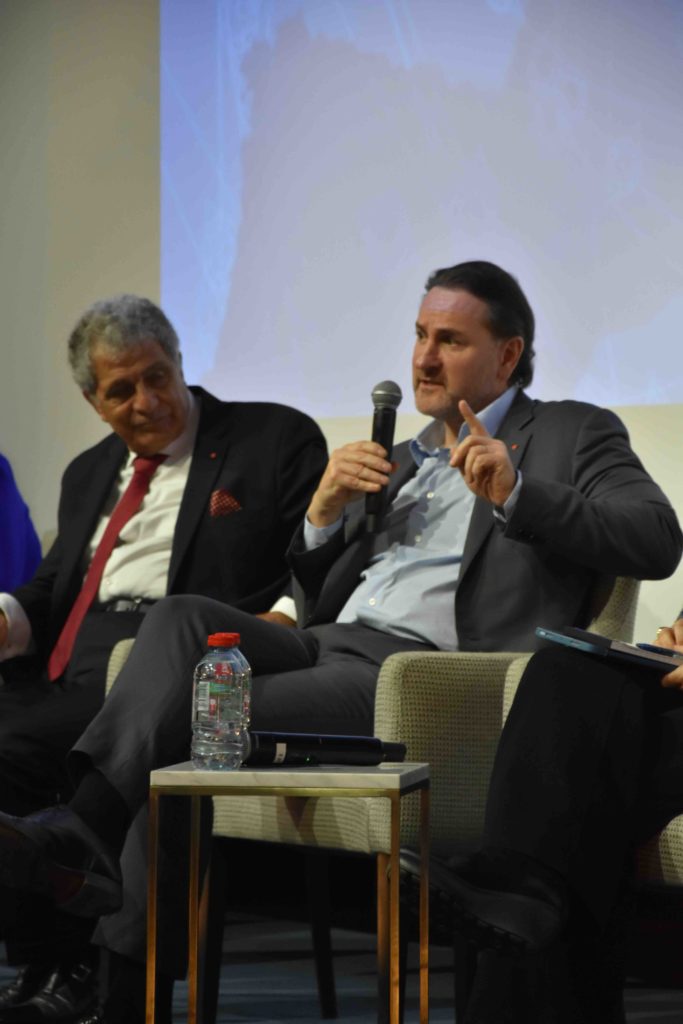
 I would like to give you a little bit of a historic background to how we came about the digital euro project. Many of you still remember when the fear of the Libra initiative by Facebook hit us. All across the world, people reacted very controversially around the idea that within a social network of 1.5 billion people, you would be able to exchange value based on a token that would travel among the participants of that network, and that would be pegged to dollars, to euros, to yens, etc. So, a global currency.
That created shock waves across the central bank milieu. Many central banks took the view that this would infringe on their sovereignty, their financial monetary sovereignty. The project was quickly “killed”, if I may call it this way. Facebook (at the time, it was not yet called Meta) tried to revive it. They created a foundation, a new name, and they tried to come back. And again, it was withdrawn.
This hype around central bank digital currencies was created at that time. About 180 central banks around the world looked at projects of creating a central bank digital currency. Today, there are three in existence. Many of you might have heard of them.
The first one was actually the Bahamas, the sand dollar. For very good reasons: the Bahamas is a series of islands disconnected from each other, geographically speaking, but also in a geographical situation that affects them with a lot of severe weather. Obviously, each time they needed to transport cash from one island to the other, they had to do that by boat. When you had severe weather conditions, hurricanes, etc., simply cash couldn’t be distributed, sometimes for many days in a row. The idea to have a digital currency that is a full equivalent of cash for such an instance of severe weather conditions and geographical disparity made a lot of sense for such a small country like the Bahamas.
The second one is Nigeria. Nigeria has a functioning central bank digital currency, but there the motivation was about inclusion and making sure that people who are very well digitally connected (everyone has a smartphone in Nigeria) but do not have bank accounts to the extent that we have in mature markets like in Europe, in the US, etc. It is a highly underbanked market from that point of view, but they have found alternative solutions. Even a country like Kenya has found alternative solutions to the banking system via mobile operators. The telecom network takes care of a lot of value transmission. The project there at the time was called M-Pesa. Today, it is one of the most successful payment systems also in Africa.
The last country is China. China has the central bank digital currency in two provinces. There are millions of people that have access to it, but very few users actually. And compared to the size of China, 1.4 billion people, it has not been scaled to any extent that could be called a success yet.
That’s it. There are dozens of countries that have decided to scale back, and we have heard it earlier, the reasons for scaling it back can be manifold. There are different motivations, often economic, often around the various factors that maybe the use cases were not sufficiently profitable (from a return on investment point of view) to go about it.
At the end of the day, my point here is that Libra is gone, but we have other actors in that space. And now looking at monetary authority or monetary sovereignty, we have to look at numbers. We have to be clear about what we’re talking about. Money in circulation in any economy can be divided between commercial bank money and central bank money. The digital euro is central bank money, a liability on the books of central banks. Meaning today here in Europe, we probably have 10%, maybe 15% of money in circulation that is central bank money. So, it is very important that the commercial banks are actually part of any solution, because they represent by far the largest majority of money in circulation.
Point number one on strategic autonomy and sovereignty. Point number two that I would like you to understand.
I do not say that with any interest to influence you: the EBA, my association, is a think tank. We are not a lobbying body, we do not create position papers. We try to be as technology agnostic as we can when we discuss these type of topics. Therefore, we set up a working group three years ago on the digital euro, trying to understand what really it does mean for banks. We looked at it, at the features and the characteristics of the digital euro, and we compared it with what we have in place today.
With the introduction of a new form of money, and the digital euro does comply with three out of the four textbook definitions of money that you find in any economics textbook (unit of account, store of value, means of exchange), it is also a payment instrument, and it will potentially compete with other payment instruments that we have developed: it will compete with instant payments in many of the same use cases; it will compete with cash, as it is a digital equivalent to cash; and it will compete with cards.
Our working group tried to understand what will drive adoption of the digital euro, and we came to the conclusion that it would be very hard to convince consumers to actually choose the digital euro over any other instrument that they have today in their wallets or at their disposal, simply because, from a consumer point of view, today we have a lot of solutions that are good, that work, and it takes a lot for a consumer to change payment habits.
We have seen it. Look at us here in France. We are still using the cheque: could you always argue that the cheque is not a separate instrument and should have been phased out? But at the same time, let us not forget that there is a law that even prescribes banks to offer cheques for free. So, as payments practitioners, we are bound by the regulatory environment, by the legal environment, etc.
Now, if the legal framework for the euro comes as promised, we might have to expect as well that the digital euro will be legal tender, you will be obliged to accept it. If that is the case, the argument that the EBA working group said is “if it does crowd out cash, your handling cost of cash will reduce, which is good because cash is the most expensive payment instrument handled by banks: it is physical, you have the transportation costs, the security costs… And even for merchants, cash is not an easy instrument and not a cheap instrument to handle.
So, we thought merchants are the most likely driver for the adoption of the digital euro because today, they pay a lot of fees on cards. And the duopoly of Mastercard and Visa, both being American, also plays into the argumentation that we create more strategic autonomy here in Europe by having an instrument, a means of payment that would be bred here in Europe.
From that point of view, you need to think about the wider ecosystem. There will be a cost for banks to implement the digital euro. We have seen different studies. The Spanish community was the first community that calculated the cost per bank of introducing the digital euro on their existing rails and how much it would cost them to create new rails just for that purpose. They did that because they wanted to understand what is the return on investment that they will have when they do it: will they comply with just accepting digital euros, or will they try to build a business, will they try to innovate on it?
The costs differ quite a bit between the two, but it is a double-digit million euros per bank to make it happen end-to-end. 14 key banks in Spain participated in that project. You have also heard from a previous speaker about the PWC study that talks about billions for the industry at large.
All of these are strong arguments, but what I would like you to focus on, as payments practitioners, is that you will need to fulfill a number of roles, which you need to prepare for, such as KYC, onboarding, providing the wallet… The European Central Bank will not do these things: the ECB is the owner of the digital euro scheme and sets the rules of the scheme, but there are a lot of operational, technical, IT-related changes that you will have to do in order to become a proactive player in this.
And I think that for the cost you have to factor in, you want to see a return on investment. We heard that there will be a compensation model, and it would be very interesting to hear what is that compensation model. The cost that merchants will be faced with is significantly smaller than the cost they today have in other instruments.
So, all of this needs to be put together and thought about if it comes. I have no doubt that the political will is very strong. If the digital euro comes, how do we, as an industry, prepare for it?
Again, I am very agnostic with the pros and cons. I am just trying, from a practitioner’s point of view, to be part of the solution and to make sure that we have an understanding of what comes our way.
2029 is not a long time to prepare for this internally. We have seen how long it took us to prepare for SEPA: it took us three years to create the EPC, three years to create the SEPA credit transfer scheme, SEPA direct debit scheme, and then it took us another number of years to create adoption and reachability. And at the end of the time, we even went to the regulator and begged them for a regulation to set a SEPA end-date so that we can stop the duality.
That is what I would like you to think about as well.
***