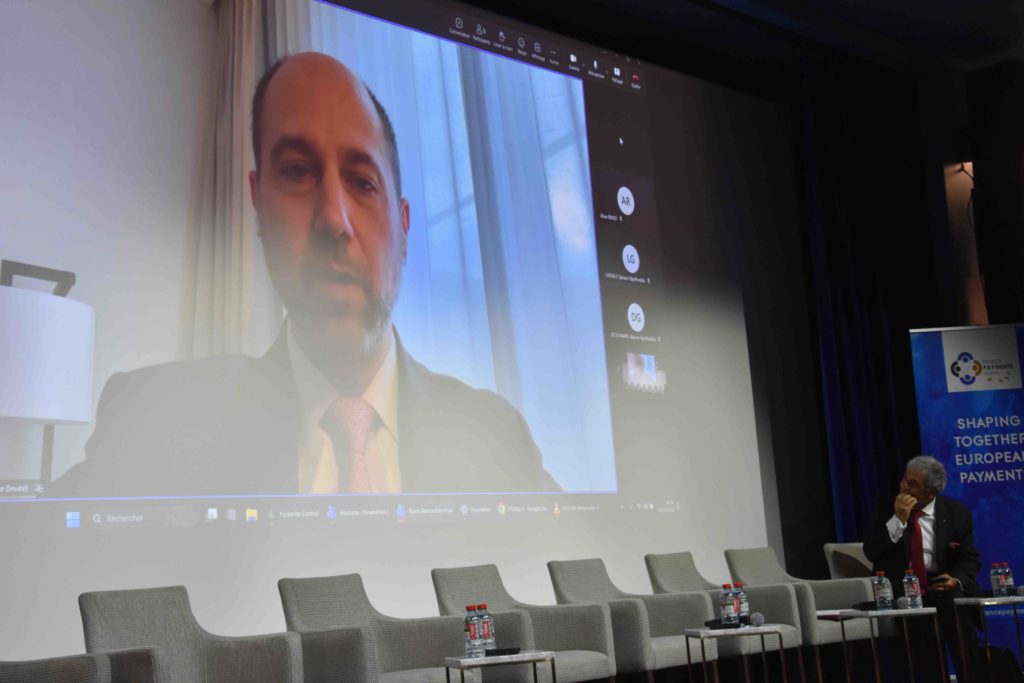
 Thank you very much for the invitation.
I support the initial comments made by the representative of the French treasury [Christophe Bories]: we need badly more coordination within Europe and in this wider range of tokenized finance, as he put it. That is starting to happen, but it started very recently. And before that, we had some fragmented approach. One of those fragmented ideas was the retail CBDC (so-called digital euro), and we have to bring that conversation into the broader landscape of tokenization of finance. I also concur the Commission’s ambition to have a strategy for tokenized finance (including tokenized deposits), but we have to put the dots together.
The digital euro, as it stands right now, is an idea that was intellectually developed many years ago in a world that no longer exists. We have to rethink about it, and some aspects are valuable, for example, the idea of having offline digital euro. Having this offline capability that goes just beyond resilience is just to tokenize banknotes. It is highly conceptual : we can have banknotes in a digital form; we can even use them for e-commerce. But there is no need, and that’s the important part, to enter in collision with account-based solutions provided by the private sector.
The main point of discussion is about the online digital euro. That is this idea of making mandatory for all merchants in Europe and citizens, on a voluntary basis, to open accounts at the ECB in order to make payments. It is an unnecessary step that creates all sort of confrontation with private sector solutions that are based on current accounts provided by deposit-taking institutions, the bloodline of their credit activity.
So, engaging in this type of competition from the central bank vis-à-vis private operators is unnecessary unless (and that is a big caveat) the private sector efforts to reach pan-European scale fail. In that case, maybe this is a cost we have to face, but as Europeans we should try to avoid it. So just to give all support to private initiatives that, based on exchanges of commercial bank money through different means, are now attempting to reach pan-European scale.
That is something we badly need, because otherwise we have an excessive level of dependence on international card schemes in payments, which gives a geopolitical risk we have to manage. Things are moving, and they are moving fast. The private sector is putting money where their mouth is. That is a novelty in a couple of decades, and we should keep this momentum and try to prevent it.
Thank you for your attention
Hervé Sitruk
Thank you very much, Mr. Navarrete. I have two questions for you. First question : in your view, could the digital euro solve the issue of sovereignty of payments in Europe?
Fernando Navarrete
Yes, it can be a solution, but I think it is not the best solution. That is why I am hopeful, and I think we have to, from the public sector, we have to give all the incentives for private sector initiatives that are trying to reach pan-European scale.
So, both are solutions, but the idea is: “which one is better, in terms of privacy, of financial stability, of long-term innovation, and in terms of costs for all Europeans, not just the public sector, but also the society at large?”.
The online digital euro is an extremely complex and costly endeavor: not just the cost for the ECB (which is now estimated at 1.3 billion) but also the cost for the banks or the financial industry in Europe (of which the estimated range is between 4 billion and 18 billion), let alone all the cost for all merchants in Europe, which is an undefined cost. So, we are talking of several tens of billions that may become unnecessary if private sector solution is given support to reach pan-European scale, even before the ECB is ready to launch.
Remember the time dimension: the ECB is claiming that they might be ready to issue online digital euro in 2029 if everything goes smoothly on the legislative side. Okay, but what happens if the private sector can do it faster? I would say: “it is cheaper, faster, more innovative, more secure in terms of financial stability. We don’t need any safeguard”.
So, the first option for us, as colegislators, should be to push for this private sector solution, and always be mindful that if they fail, then we have to be ready. And then, as a second best or fallback option, online digital euro can be part of the pudding, but not as a first ingredient. Simply as a fallback option.
Hervé Sitruk
Second question: in your view, could Wero and the hub they are organizing with EuroPA also solve the issue of sovereignty in Europe? And what could be the support of public authorities to this market-led solution?
Fernando Navarrete
Could they solve the issue?
Yes, it has the potential to be a solution, but that potential has to be transformed in a reality. We have to understand the frustration of public authorities, especially central banks, that in two decades we have a single currency, but not an integrated payment system in Europe. This is a frustration that I fully share.
Now, the private sector is really with this strategy of cooperation or interoperability. It has the potential to do it. Let us give them a chance. They are investing, they have a new strategy, it is working, but only partially working. It has to go further, so as to provide full services, namely the three standard use cases (peer-to-peer, point-of-sale and e-commerce), for at least 21 Eurozone Member States. This cooperation or interoperability between Wero and EuroPA is a step forward, but still lacking some scale, since it is not covering the whole Eurozone. They have plans to do so, and we need to see action, and to see action fast.
That is why, in the proposal legislation that we are discussing now in Parliament, we are basically saying: “Okay, the private sector has to demonstrate that this potential is reality”. They have to reach this pan-Eurozone scale before the ECB is ready to launch. It has the potential, but they have to demonstrate: the time of just promises and plans is not enough. You are the agents of this change: I think you take it seriously, you are investing, you think you have a chance. Just prove us that you can do it.
How to support it?
First of all, the time of giving explicit support through subsidies or regulatory support, this time has passed.
What we can try to do from the legislative side is not to prevent that from happening. My fundamental concern about the digital euro Commission’s proposal, is that as long as it is mandatory for all PSPs to distribute, if we make that distribution unconditional i.e. regardless of what happens in the private sector, we are going to have an online digital euro unconditionally, and then we are in this zero-sum game with scarce resources, and you are forcing PSPs to decide whether to put their money. As long as it is mandatory, you have to do it, and therefore we will prevent this potential of private solutions to get to full fruition.
Having that unconditional issuance will be a fatal mistake, because we will be preventing these promising efforts by the private sector. That is why I want to make it conditional: if the private sector fully provides services for all the Eurozone, then there is no need for the online digital euro.
That is a more subtle approach, but also incentive compatible for everybody trying to do their best, at this time that Europe badly needs more sovereignty in the retail payment space.
Hervé Sitruk
Thank you very much, Mr. Navarrete.
***